Showing posts with label Local Development Framework. Show all posts

Wednesday, 10 June 2009

69 - 71 Bondway SW8 - Planning Permission sought

Planning permission is currently being sought for: Bondway Commercial Centre, 69 - 71 Bondway, London SW8 1SQ. Application number is 09/01520/FUL and comments can be made by clicking the link. Vauxhall Bondway Ltd are proposing to develop a 42 storey building on the site. I think that would be of equivalent height to the Strata Building in Elephant and Castle. Most peoples' question is "Where's Bondway?". It's here:


I'm not sure how this one slipped under the radar (you have until 24/6/2009 to comment), so I am going to refer you to the Viva Vauxhall blog (which represents the roads around Bonnington Square) where they have an excellent post which lists their reservations about the development and might give you some basis with which to support or oppose the planning permission request.

The building is technically not in SE11. It's some way over the border in SW8. However, when proposed buildings are so tall, they impact on everybody that lives locally. I imagine the building will overshadow Fentiman Road, Bonnington Square and Vauxhall Grove. The question is... exactly which part of Vauxhall is it considered acceptable to place tall buildings? It was clarified at the Kennington Oval and Vauxhall AGM last night that it was considered appropriate in the draft Vauxhall Supplementary Planning document to raise tall buildings around Vauxhall station. The concept of what counts as Vauxhall station is somewhat hazy. I've read the draft Vauxhall Supplementary Planning document, but haven't given it the amount of analysis that I gave to the draft core plan for the Local Development Framework. It looks like it's time to go back to the Vauxhall Supplementary Planning document and provide a summary. When I've done that, I'll post it here to be of assistance for those commenting on local planning proposals.

It's worth mentioning at this point that the Vauxhall Supplementary Planning document will remain in "draft" stage until one of the wider documents related to the London Plan is released for consultation (in order to check that the two line up and Lambeth aren't heading in a different direction from the rest of London). That document won't be consulted until September 2009 so the draft Vauxhall SPD will remain in draft format for some time.

Edit (11/6/2009): Tradescant Road blog has also commented and posted a helpful picture of various elevations of the proposed development.

Monday, 11 May 2009

81 Black Prince Road grounds of appeal

OK, after a number of hiccups, I now have the 81 Black Prince Road grounds of appeal in .pdf document form. It's only about 4 pages long so will not take as long to read as other recent missives!

Quick history:
As you'll have seen from the previous post on 81 Black Prince Road, Ristoia Ltd put in a request for planning permission to build a 23 storey building on the above site. The request was refused on 5 grounds by Lambeth Council. Ristoia Ltd have now appealed against Lambeth's refusal to the Planning Inspectorate. Consequently, those individuals (and groups) who objected to the building before can now object to the reasons for appeal and those objections must be submitted to the Planning Inspectorate.

I'm going to provide a quick summary, but I suggest that those people (or groups) that are appealing refer to the document itself

[NB. I'm slightly confused because Lambeth's minutes noted four grounds for refusing the building (see my previous post), but the document I'm quoting lists five.]

1a. Lambeth's ground 1 for rejection:
"The harm that would be caused to the setting of the World Heritage Site"
2a. Lambeth's ground 2 for rejection:
"Impact on the setting of listed buildings and adjoining conservation areas"

1b and 2b. Ristoia's objection to Lambeth:
Professor Robert Tavernor (probably helps that he's a professor) did the assessment and decided that the proposed building wouldn't be harmful to either South Bank House or London Fire Brigade Headquarters. By the way, here's a picture of the absolutely exquisite South Bank House:
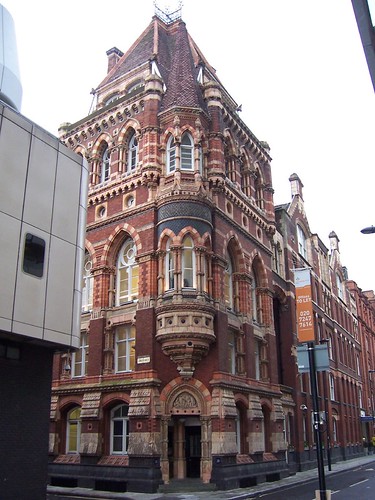


Isn't it fabulous? And since they don't think it would harm (or overshadow) buildings such a these, they think that it complies with Policies 45 and 47 of the Lambeth UDP.

Additionally, they list policy 33 of the UDP, which assesses the criteria for suitability of sites and states that major development needs to take into account the adjacent townscape (which they think it does) and they also list the regeneration aims for the Albert Embankment, and, importantly, "consents granted for other tall buildings in the area" as reasons to proceed.

Also, they note that Policy 58 of the UDP states that the Albert Embankment is a "key stretch" of Lambeth's Thames frontage for "several major development proposals". Bizarrely, they consider that the fact that the building has "been designed as a sculpted pinnacle" is something that adds (rather than detracts) to the Albert Embankment.

Finally, Ristoia Ltd appeal to to Policy 40 in the UDP. Policy 40 is the "tall buildings" policy.

1c and 2c. My suggestion to all individuals objecting to the appeal:

Focus on why you don't think it complies with policies 45 and 47.

They're citing "other tall buildings in the area" as a reason to build. This threatens to set a dangerous precedent. There are some other tall buildings which were granted permission on Stockwell/Vauxhall border, and St George's Wharf in Vauxhall, but erecting this building risks making the Albert Embankment into another area in which tall buildings might be permitted. The Salamanca Tower is tall enough and I suggest that no new building be higher than that.

In objecting to their interpretation of Policy 33 and 58, I would argue as follows: "Yes, the Albert Embankment is listed as a focus for development proposals, but this site is not on Albert Embankment, it's actually on Black Prince Road, which is a highly residential area and full of low rise /medium rise buildings." The "sculpted pinnacle" effect does not work well when looking from Black Prince Road on to the Albert Embankment (south to north).

Finally, look closely at Policy 40 in the Lambeth UDP. The first aloowance that they give for tall buildings relates to Location and notes very specifically, "Tall buildings should not be located where they would harm the character of "conservation areas", "listed buildings", "riverscape and townscape", "strategic views" and "the Palace of Westminster Heritage site". Also, let's think back to some of the work I did recently on the draft Core Policy for the Local Development Framework. p63 (Vauxhall) notes that 'Along the river, Lambeth are anxious to avoid creating a wall effect, blocking out the Thames and want sufficient gaps between buildings.' Also, I failed to spot this line at the time, but p56 of the draft Core Policy says "Appropriate locations for tall buildings are the Vauxhall and Waterloo London Plan Opportunity Areas and the borough’s major town centres, subject to appropriate accompanying urban design assessments." It is very important to note that Black Prince Road could, by no stretch of the imagination be considered Vauxhall or Waterloo. I would argue that it is the riverside portion of Kennington, and most people might once have referred to it as just "Lambeth" due to the proximity of Lambeth Walk.

3a. Lambeth's ground 3 for rejection:
"Proposal would have an adverse impact on setting of Palace of Wstminster and Westminster Abbey World Heritage Site and would undermine important setting of St Stephen's Tower". [Ed: Where did this one come from? It doesn't seem to be in the meeting minutes...]

3b. Ristoia's objection to Lambeth
The applicant was supported by a Townscape and Visual Impact Assessment which concluded the development wouldn't harm either of the two sites or the views, and in fact, there's a neglible impact on the skyline from Whitehall.

3c. My suggestion to all individuals objecting to the appeal:
This one is a bit odd. It's entirely subjective. Lambeth say "X is true" and Ristoia basically just say "X is not true". I've no idea how one goes about disagreeing with a Visual Impact Assessment in an objective manner.

4a. Lambeth's ground 4 for rejection
"Poor quantity and quality of the proposed amenity space."

4b. Ristoia's objection to Lambeth
Interesting. On this one, Ristoia's reason of substance is "Reason 4 for refusal is unreasonable." and "The treatment of the open space is of a sufficient high quality".

4c. My suggestion to all individuals objecting to the appeal:
Hmm. Again, rather difficult to be sensible here. Perhaps it might be possible to proceed on the following grounds... p31 of the draft core strategy of the Local Development Framework states something like, "Lambeth, particularly in the north has little open space relative to population." If I recall correctly, it even talks about hectares... Hmmm. Oh yes, p16, "There are 1.54 hectares of unrestricted open space in Lambeth per 1000 of the population, but access is unevenly spread and limited in north of the borough". So perhaps objections might centre around the fact that with limited open community space around here, an extra special effort must be made to provide more than would ordinarily needed. What do readers think?

5a. Lambeth's ground 5 for rejection
"Overbearing impact of the proposed development and the creation of a sense of enclosure (particularly re. Salamanca Square)."

5b. Ristoia's objection to Lambeth
Development has been carefully designed to minimise overlooking issues and designed so that distance between adjacent buildings wouldn't have overbearing impact on nearby residents. Therefore, the proposals wouldn't result in sense of enclosure and overbearing impact. They quote policies 33 and 40 of the UDP.

Also, the development is sustainable and brings employment and housing that should regenerate the area.

5c. My suggestion to all individuals objecting to the appeal:
Oh dear. Again, it's another tit for tat objection. I have no idea how the Planning Inspectorate views these in any objective manner. Perhaps it's time to order some planning law books!! What's the likelihood that there are some rather important people living in Salamanca Square eg. MPs, who don't want people looking in their bedrooms? :) Seriously though, I suppose it's time to enter the nitty gritty of polcy 33 in the UDP (p94). However, I can't see any way of objecting to this sensibly "xii" is "not creating unacceptable overlooking", but who exactly is supposed to say what "unacceptable overlooking is"?

Wednesday, 15 April 2009

Local Development Framework - Draft Core Strategy [Sections 5, 6 and 7]

Lambeth council recently released a draft version of its "Core Strategy", which is the most important document contained in the "Local Development Framework". The entire document is 116 pages long, although the Council welcome comments. I've been sifting through it over the past few days have and produced a cut-down version, mostly just summarising what was written. I've not changed their wording much, but have shortened and simplified because it contains some interesting ideas for the Borough.

I've used the document headings where possible, but have not summarised every section as it's a highly repetitive document.The terms in purple are the "key" definitions.
The insightful comments in red are my comments. Due to length of the document, I've split my summaries into separate blog posts.

Section 5 – Spatial Planning Issues

In order to achieve sustainable development over next 15-20 yrs, the Core Strategy must address 6 key issues:

1. Accommodating population growth (p24)

According to the mayor’s London Plan, Lambeth must find space for additional 1100 homes every year until 2016/2017. This target has been exceeded for the three yrs since 2005/6. Demand will come as Lambeth children grow up, existing households break into smaller units, and adults/families migrate to the borough to find work and a place to live. Affordability is a struggle in Lambeth where entry level price for housing is high compared with household income. Lambeth’s essential public services find it hard to retain key workers because they can’t afford to live close to whether they work. Lambeth need to identify an additional four pitches for gypsies and travellers in Lambeth.

2. Achieving economic prosperity and opportunity for all (p26)

Lambeth is prosperous, but with pockets of extreme poverty. The poverty is in commercially vibrant areas eg. Waterloo/Brixton. Therefore skills shortages are filled by migrant labour which then increases demand for local housing, transport and services. The Core Strategy will contribute to tackling these barriers by maintaining a supply of local job opportunities. Affordability of premises is an issue for some businesses eg. creative sector and social enterprises.

Waterloo and Vauxhall present the most significant potential for commercial development and job growth in the borough, as well as potential for new housing. However, this will not happen unless the capacity of the public transport infrastructure serving these areas also grows at a sufficient rate. Major developers will be expected to help meet the cost of increasing this. (p27) [They will probably be able to tick the boxes to say that this is done if the developers of Battersea Power Station add two additional tube stations to the Northern Line, but I’m not sure whether those will fall strictly in Lambeth. I think that one of them will. It doesn’t really help anybody living towards the south of the Borough]

Lambeth’s hierarchy of town centres presents another opportunity. New shops need to be located in a way that supports, rather than undermines existing town centres. Brixton and Streatham have potential for new commercial and residential development. This will help secure their future in the face of retail and leisure expansion at Elephant and Battersea. Clapham High Street is thriving. Other high streets need careful regeneration eg. West Norwood, Stockwell [where exactly is Stockwell High Street?] and Herne Hill (p28).


3. Tacking and adapting to climate change (p29)

Most important contribution is to reduce carbon emissions by meeting needs locally, promoting alternative to the car, sustainable design of buildings, re-use of existing buildings, renewable energy, safeguarding allotments, retaining/promoting tree growth, urban greening and reducing landfill waste. [I detect a clash of goods between attempting to build the council housing stock on certain open land, versus promoting green spaces in the north of the Borough. Watch this space.] However, there will still be a need for appropriate car usage, and parking, including for those with mobility difficulties.

4. Providing essential infrastructure (physical, social and green) (p31)

It won’t be possible to achieve the significant levels of housing and economic growth set out in the Core Strategy without supporting transport infrastructure. [This point is reiterated throughout the document, but other than the proposed Northern line extension, I can't see where the investment might come from to promote this.] North/south transport is better than east/west transport and major developers in worst locations will be expected to supplement significant future public sector investment. More land is required for schools. Lambeth, particularly in the north has little open space relative to population. More open space is needed for burial sites.

Lambeth has various sites for sustainable waste management, but does not have the quantity to manage 486,000 tonnes (the prediction by 2020) (p33). [This is very interesting, and presumably all Boroughs have similar problems. I wonder what community strategies could be promoted for reducing waste.]

A general theme running through all partners’ programmes is trend towards neighbourhood based delivery so local facilities need to be increased to promote adult learning, skills training, English language tuition, employment support, child care etc. [I detect another clash of goods between promotion of "local" high street services (Brixton/Streatham) and development of large retail establishments (Elephant and Vauxhall). The document does actually mention this, but fails to outline how all of the community/retail areas are to grow co-operatively.]

5. Promoting community cohesion and safe, liveable neighbourhoods (p33)

Some communities feel their neighbourhoods lack stability and not enough households stay long enough to put down roots. [That’s probably a correct assessment if one considers that there’s a yearly churn of 20%! See previous post.] Residents in some parts of the borough feel that communities are essential to stable community and that the loss of family housing to flats is damaging that. The Core Strategy seeks to address that. Multiple social problems frequently occur on existing social housing sites and it’s difficult for those communities to make positive changes. [Unsurprisingly], some of these estates fail the “decent homes” standards. [It’s not clear whether “the decent homes standards” relate to the figure on p14 that one third of council housing is “unfit”. I suspect it doesn’t, but I’m not clear what the decent homes standards are, and since it sounds alarming, it would be useful to have this outlined.] Communities need spaces that allow informal day-to-day contact and social interaction. Lambeth has such buildings eg. youth centres, places of worship, cafés, local shops, but coverage is uneven and some have shortages of useable space, while others have under-used facilities. Space for young people is a priority in areas where unemployment/gang activity is high. [I hope they've read the studies that suggest that unstructured youth clubs can actually increase crime.] Lambeth has no central volunteer centre. [Interesting point. A volunteer centre would be an interesting proposal.] Large church congregations struggle to find good sized premises in good locations. In the South of Lambeth, there’s a lack of play facilities.

6. Creating and maintaining attractive, distinctive places (p35)

Historic assets are currently under used. The Core Strategy intends to pay particular attention to proposed development on the River Thames. High density development will continue to be essential to meet Lambeth’s needs over next 10-15 years. Tall buildings are appropriate for some uses and in some locations. The Core Strategy encourages high density development, including tall buildings, where of high quality and appropriately located. [I still wonder where tall buildings are ever appropriately located. I wish somebody would do some work on whether tall buildings create or deter community cohesion.] The large number of artists is a distinctive feature of Lambeth and they have specific space needs. Local shops, independent businesses and street markets are essential to identity. These include gay businesses in Vauxhall, Brixton/Lower Marsh markets, Portuguese businesses in Stockwell and Somali businesses in Streatham.

Section 6 – Spatial Vision and Strategic Objectives & Section 7 – Strategic Policies

These sections reiterate much of the above, but p38 has an optimistic and visionary idea of Lambeth in 2030. p42 has a map, showing transport hubs and key areas. p46 sets some housing targets that I haven’t seen elsewhere in the document.

---

Section 8 will probably appear tommorrow. It is quite interesting, but is taking a while to summarise because it deals with local areas, and is quite information heavy.

Local Development Framework - Draft Core Strategy [Sections 1 and 2]

Lambeth council recently released a draft version of its "Core Strategy", which is the most important document contained in the "Local Development Framework". The entire document is 116 pages long, although the Council welcome comments. I've been sifting through it over the past few days have and produced a cut-down version, mostly just summarising what was written. I've not changed their wording much, but have shortened and simplified because it contains some interesting ideas for the Borough.

I've used the document headings where possible, but have not summarised every section as it's a highly repetitive document.
The terms in purple are the "key" definitions.
The insightful comments in red are my comments.

Section 1 – Introduction

A Local Development Framework (LDF) is a collection of documents designed to guide development of a borough over 15/20 years. The Core Strategy is the first and most important document in the LDF. A Local Development Framework must achieve sustainable development for the area it covers. The four guiding principles for sustainable development are: Social progress, Environmental protection, Prudent use of natural resources and High levels of economic growth and employment. (p4)

The Lambeth Sustainable Community Strategy is a document used to prepare The Core Strategy, and the Sustainable Community Strategy contains data related to social, economic and environmental wellbeing, including health and community safety information. (p92)

Overall vision for Lambeth Sustainable Community Strategy is that by 2020 Lambeth will be a diverse, dynamic and enterprising borough at the heart of London, and there are 7 long term outcomes for the area:

* Great place to do business with high investment
* Greater well being for households through more residents in employment
* More young people on path to success
* Safe and cohesive places where people are empowered and play active roles in communities
* Improved health / well being of people to live independent lives
* Lower levels of poverty / exclusion by helping adults into employment, education and training
* Mixed and sustainable communities with more new homes, improved existing dwellings and environment

Lambeth’s LDF will be important tool to implement spatial aspects of outcomes such as geographical inequality, new housing and jobs and delivering infrastructure. (p6)

Significant proportion of Lambeth Core Strategy is dependent on private sector for delivery, re. new housing and commercial development; offices, etc. This is dependent on availability of development finance through the market. The Lambeth Core Strategy is meant to be flexible enough to enable private sector development at all stages of economic cycle.

Section 2 – Evidence Base

Population and Diversity

Lambeth covers an area area of approximately ten and a half square miles and population projected to grow 17% to 317,000 by 2026. Lambeth is among the most densely populated areas in the country, and current household composition includes high proportion of single parent households with dependent children. Population churn is estimated at 20% every year. [That’s very high! I didn't realise that so many people stayed in Lambeth so briefly.] (p13)

Lambeth is even more ethnically diverse than rest of London. The largest groups of immigrants between 2002 and 2006 were Polish, and after that Australian, and then Jamaican. [It seems to me that it’s a bit pointless to have “diversity” be an aim of the Sustainable Community Strategy when this has clearly already been achieved and is unlikely to change!] (p13)

Deprivation

2007 Index of Multiple Deprivation places Lambeth as 5th most deprived borough in London and 19th most deprived in England, which is worse than 2004, and is a result of improvements in other boroughs as well as a decline in Lambeth of income, health/disability, living environment and access to housing/barriers to services. (p13). The most deprived areas are spread, but concentrated in Coldharbour ward in Brixton, and Crown Lane area of Knights Hill ward. Most affluent include the Thames-side part of Bishops and Dulwich borer area of Thurlow Park (p14).

Housing

Lambeth’s housing consists 70% flats and 30% houses and is typical of inner London. Price of an average dwelling is around £350k in December 2007, but this had decreased by approx. 12% by December 2008. [That brings down the average dwelling to being worth £308k by my calculations.] Average gross household income in Lambeth is 31k per year. [My guess is that that's quite low for London as a whole.] (p14)

32% of council homes and estimated 11% of private sector dwellings were assessed as “unfit” by Council’s private sector stock condition survey in 2004. [That is bad. Are they really saying that a third of council homes are unfit for habitation? Are people actually living in them?] There are just under 2k households living in temporary accommodation (Dec 2008), and 13kish households in “housing need” within the Borough. (p14)


Economy

There are around 10k businesses in Lambeth. 75% of these have fewer than 5 employees. Lambeth has third lowest business density per head of population across inner London, but numbers of VAT registered firms grew by 14% between 2002 and 2006. [This will probably drop again due to the recession.] (p14)

There’s a cluster of large employers around Waterloo/Vauxhall. Over half of Lambeth’s existing jobs are located in Waterloo/South Bank area. The borough suffers high rates of unemployment – 71% of working age people employed in 2007/2008 in Lambeth compared with 70% across London and 74% nationally. (Doesn’t sound that bad to me, compared with the 70% figure for whole of London). Lambeth has one of highest number of incapacity benefit claimants (p15).

Education and Transport

Lambeth has 86 schools of which 13 are secondary. There’s a shortage of secondary places in the borough. There are very few surplus places in Lambeth primary schools and demand is expected to rise. Over 123 community languages are spoken in Lambeth schools in addition to English. (p15)

There are 14 overground railway stations spread evenly and 8 underground stations mainly in the north, with many bus routes. Residents in Streatham and West Norwood are dependent on rail and bus connections. Half of households don’t have access to a car, which is one of highest proportions in the country. Traffic congestion is a serious concern for residents. (p16)

Environment

There are 1.54 hectares of unrestricted open space in Lambeth per 1000 of the population, but access is unevenly spread and limited in north of the borough (p16). Total energy consumption in Lambeth is 3.2% of total energy consumption in London [seems quite low to me, considering Lambeth's high population, but this might be due to lack of industry]. In September 2008, an estimated 6700 households were in fuel poverty. Lambeth has lower levels of carbon dioxide emissions at 5.5 tonnes per 1000 population than London as a whole (6.8 tonnes). Despite predicted improvements in air quality in Lambeth over next 4/5 years, some measures eg. Nitrogen dioxide will continue to fail government targets (p17).

In line with targets, 25% of Lambeth household waste was recycled in 2007/8 and that has increased steadily from less than 10% in 2001/2002. Lambeth ranked 20th for house household recycling and composting in 2007/8 amongst London boroughs (p17). [It sounds as though Lambeth have taken vast steps forward, but there must be some way to go, since 20th is quite a long way down! Would be interesting to have a ranking compared to the country as a whole.]

Health and social care

Lambeth scores the 4th worst in London on unhealthy lifestyles and obesity is growing among young people. There are an estimated 5029 people in borough for whom drug use is a problem. [I expect this is a chronic underestimation because these stats. are likely to be very difficult to measure, and underestimating means that provision of services can be avoided.] Lambeth has one of highest incidence of mental health issues in capital, particularly among residents from ethnic minority backgrounds (p18).

Lambeth has a high and increasing birth rate, and numbers expected to live over 85 years old will increase demand in care services. Lambeth has the highest teenage conception rate in the UK (p18). [That’s a news headline if ever there was one.]

Community Safety

p18/19 Comparing London Boroughs, Lambeth had 4th highest count of Total Notifiable Offences (which includes majority of crimes, but excludes more minor offences), but that has been reducing since 2003/2004. Gun enabled crimes are high but decreasing. Tackling gang related crime, violent extremism and threat of terrorism are growing priorities for the borough. Crime in Lambeth is high around public transport interchanges.

[Even my cut down version of the document is long (around 4k words), so I'm going to post the next interesting sections as separate posts just to break it down somewhat.]

Label Cloud